
The Three Circles: A Practical Guide to Regaining Clarity
“Happiness and freedom begin with a clear understanding of one principle: Some things are within our control, and some things are not.” Epictetus
The model below originates (in part) in ancient Stoic thought — emphasis on inner control (thoughts, reactions) and acceptance of what’s beyond.
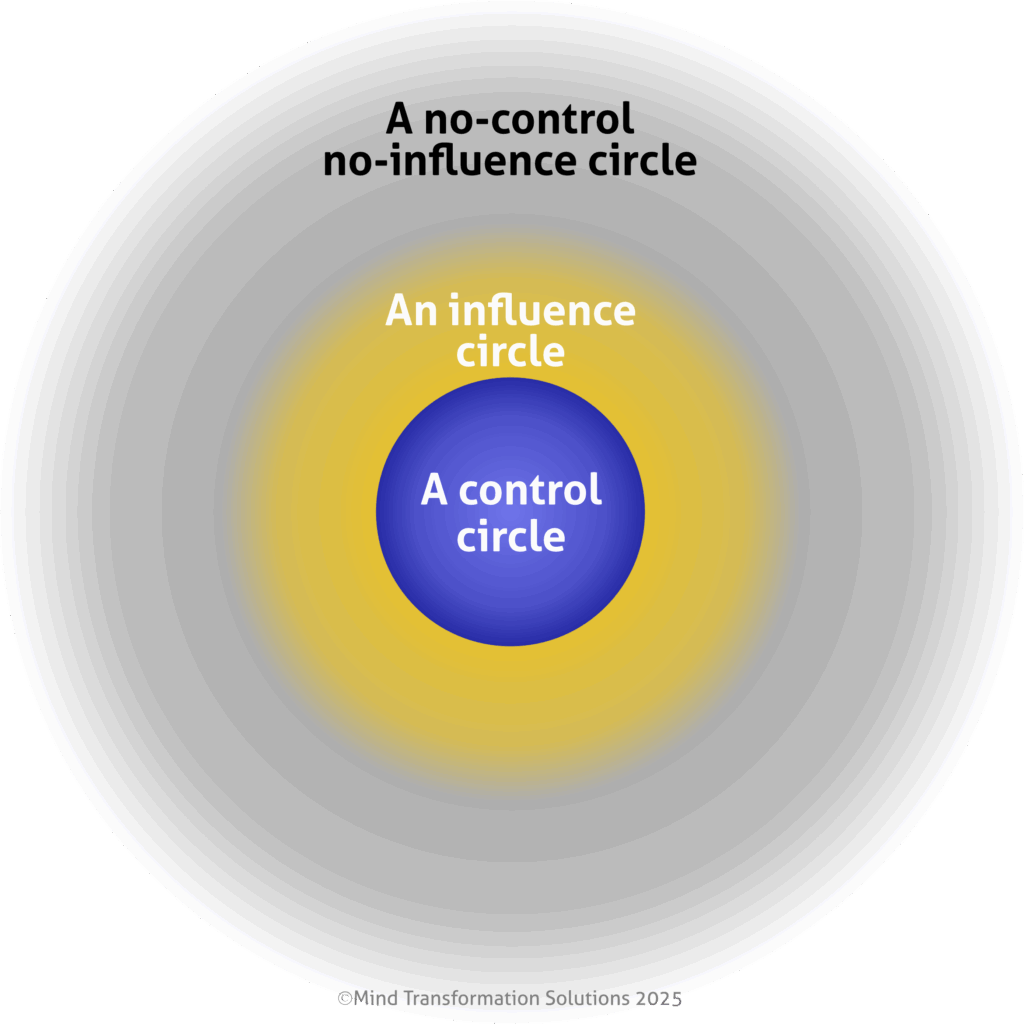
There comes a moment — familiar to most people who’ve lived through stress, conflict, or simply too much happening at once — when life feels overloaded. Things pull in different directions, everyone wants something, and beneath it all sits a quiet question: what here is actually mine to carry?
The diagram above isn’t decoration. It’s a way of sorting your energy so it stops leaking into places where nothing changes, no matter how much effort you put in. It’s a simple map of where your real power sits, and where it doesn’t — even if you wish it did.
This isn’t theory for a rainy day. It’s a working tool.
1. The Control Circle — your centre of gravity
The centre is deliberately small. It contains only the things that are truly yours:
your behaviour, your decisions, your tone, the way you use your attention, your habits, your boundaries.
You can’t control someone’s reactions. You can’t control the economy or the past.
But you can control how you respond to what’s in front of you, and how you organise the environment around you so it supports you rather than slowly draining you.
Psychology is surprisingly consistent here: people who focus on what they can control tend to feel more grounded, more resilient, and frankly more capable of handling the messiness of life (PositivePsychology.com; Beckett-McInroy).
Do:
– tighten your boundaries a little, even if imperfectly.
– change what you can today.
– choose a response that matches who you want to be.
– adjust your environment instead of waiting for it to adjust itself.
Don’t:
– let others decide for you because it feels easier in the moment.
– try to manage someone else’s inner climate.
– take on tasks or obligations that belong to other adults.
– interpret external events as personal judgements.
2. The Influence Circle — where your actions matter, but not fully
Around the centre sits the influence circle — warmer, wider, slightly more alive.
Influence is relational: it moves through example, tone, consistency, timing, boundaries, conversations. Sometimes through silence.
But influence isn’t control in disguise. It never was.
Most exhaustion comes from confusing the two: trying to force outcomes you can only affect, or investing in people who don’t move at the pace you want (MPLS Oxford; Ross McIntosh).
Do:
– speak clearly.
– model the behaviour you’d like to see.
– build conditions where good outcomes become more likely.
– use explanation, reasoning, tone.
Don’t:
– expect others to change because you’re ready for them to.
– assume influence gives you ownership of their choices.
– push, guilt, or supervise another adult’s psychology.
– treat influence as a guarantee.
Influence works best when there’s no pressure behind it.
3. The Outer Circle — no control, no influence
The grey field is large because reality is large.
It holds everything that touches your life but doesn’t respond to your effort: global events, politics, the weather, other people’s decisions, family history, the past, timing that wasn’t yours to choose.
You can care about these things. You simply can’t shape them.
Most sources agree on one thing: the more energy you spend on this outer band, the higher the anxiety, frustration, and sense of helplessness (CalmTogether; PositivePsychology.com; ColdShowerSuccess).
It’s not because you’re weak — it’s because the structure is wrong.
Do:
– acknowledge what’s happening without letting it swallow your day.
– protect your bandwidth.
– pull your attention back inward when you notice it drifting out.
– let some things stay unresolved without calling that defeat.
Don’t:
– fight battles that can’t be influenced.
– ruminate on what you can’t touch.
– wait for others to behave differently before you move forward.
– claim responsibility where you have no actual power.
Letting go here is not resignation — it’s accuracy.
4. How to use this model day to day
The three circles aren’t abstractions. They’re a diagnostic: a way of checking where your attention is sitting right now.
When you feel overwhelmed, ask:
1. What here is fully mine?
If it sits in the control circle — act.
2. What can I shape?
If it sits in influence — engage gently, with no insistence on the outcome.
3. What answers to no action of mine?
If it sits in the grey zone — step back, at least for today.
It’s remarkable how much tension drops when you stop negotiating with things that won’t move.
5. A closing note
You don’t need to sort everything.
You don’t need to change everyone.
You only need to stand where your power actually is.
When you work with these circles honestly, something steadies:
your effort starts landing where it matters, your influence grows naturally, and the outer noise loses its authority over you.
It’s a quieter path — and a far stronger one.
Sources
- PositivePsychology.com — Understanding the Circles of Control, Influence & Concern.
- Beckett-McInroy.com — Circles of Concern, Influence and Control (Article).
- MPLS Oxford — Circles of Influence Training Material.
- Ross McIntosh — The Circles of Concern, Influence & Control.
- CalmTogether.co.uk — Understanding the Circles of Control and Influence.
- ColdShowerSuccess.com — Circles of Influence, Concern and Control: Explained.